|
Where do we stand?͏ ͏ ͏ ͏ ͏ ͏ ͏ ͏ ͏ ͏ ͏ ͏ ͏ ͏ ͏ ͏ ͏ ͏ ͏ ͏ ͏ ͏ ͏ ͏ ͏ ͏ ͏ ͏ ͏ ͏ ͏ ͏ ͏ ͏ ͏ ͏ ͏ ͏ ͏ ͏ ͏ ͏ ͏ ͏ ͏ ͏ ͏ ͏ ͏ ͏ ͏ ͏ ͏ ͏ ͏ ͏ ͏ ͏ ͏ ͏ ͏ ͏ ͏ ͏ ͏ ͏ ͏ ͏ ͏ ͏ ͏ ͏ ͏ ͏ ͏ ͏ ͏ ͏ ͏ ͏ ͏ ͏ ͏ ͏ ͏ ͏ ͏ ͏ ͏ ͏ ͏ ͏ ͏ ͏ ͏ ͏ ͏ ͏ ͏ ͏ ͏ ͏ ͏ ͏ ͏ ͏ ͏ ͏ ͏ ͏ ͏ ͏ ͏ ͏ ͏ ͏ ͏ ͏ ͏ ͏ ͏ ͏ ͏ ͏ ͏ ͏ ͏ ͏ ͏ ͏ ͏ ͏ ͏ ͏ ͏ ͏ ͏ ͏ ͏ ͏ ͏ ͏ ͏ ͏ ͏ ͏ ͏ ͏ ͏ ͏ ͏ ͏ ͏ ͏ ͏ ͏ ͏ ͏ ͏ ͏ ͏ ͏ ͏ ͏ ͏ ͏ ͏ ͏ ͏ ͏ ͏ ͏ ͏ ͏ ͏ ͏ ͏ ͏ ͏ ͏ ͏ ͏ ͏ ͏ ͏ ͏ ͏ ͏ ͏ ͏ ͏ ͏ ͏ ͏ ͏ ͏ ͏ ͏ ͏ ͏ ͏ ͏ ͏ ͏ ͏ ͏ ͏ ͏ ͏ ͏ ͏ ͏ ͏ ͏ ͏ ͏ ͏ ͏ ͏ ͏ ͏ ͏ ͏ ͏ ͏ ͏ ͏ ͏ ͏ ͏ ͏ ͏ ͏ ͏ ͏ ͏ ͏ ͏ ͏ ͏ ͏ ͏ ͏ ͏ ͏ ͏ ͏ ͏ ͏ ͏ ͏ ͏ ͏ ͏ ͏
Where do we stand on the Woman Question?
|
|
|
|
Kim Hoeckele, Standing Woman, Archival Pigment Print, 40 x 71 inches, 2023 |
|
|
|
|
Hi everyone, First: Thank you to everyone who responded to my fall email-essay. I’m so grateful for your time, and for the conversations it sparked. This quarter, I’m writing in parallel with my photograph, Standing Woman, titled in reference to Alberto Giacometti’s many sculptures of the same. Along the way, I explore Helmut Newton’s Big Nudes, the Mesopotamian poet Enheduanna, a goddess obsessed with her vulva, and the socialist activist Theresa Malkiel, who established a National Women’s Day of protest–a precursor to our modern International Women’s Day on March 8th. You can read it all below a couple of updates, or, if you prefer, in your browser by clicking the link at the top of the email.
|
Ancient Modern I’m excited to participate in the group exhibition Ancient Modern at Underdonk with artists Michael Barton-Sweeney, Angela Conant, a/d Gayle, Whit Harris, Steve Keister, Jennifer Macdonald, Shari Mendelson, Jasmine Murrell, Deirdre Swords, and Gabriela Vainsencher, organized by Elisa Soliven. The photograph I wrote about last fall, Society of Diana, will be included. <3 Right: Society of Diana, 40 x 50 inches, 2024 |
|

|
|
|
|
Exhibition Dates: March 7–March 30, 2025
Opening Reception: Friday, March 7, 6–8pm
Address: 191 Henry Street, New York, NY 10002
|
|

|
Part-time SoberDuring dry/ damp/ wet January, I did a quick photo illustration for the Wall Street Journal for a story about part-time drinking. I really enjoy photo illustration assignments and their constraints–both time and creative–and I am looking to take on more this year. Please reach out if you’d like to collaborate on something! |
|
|
|
Ok, now to the Woman Question! And, if you know someone who might enjoy this, please forward it along–they can subscribe here. (and you can unsubscribe at the bottom). Until spring,
Kim
|
|
|
|
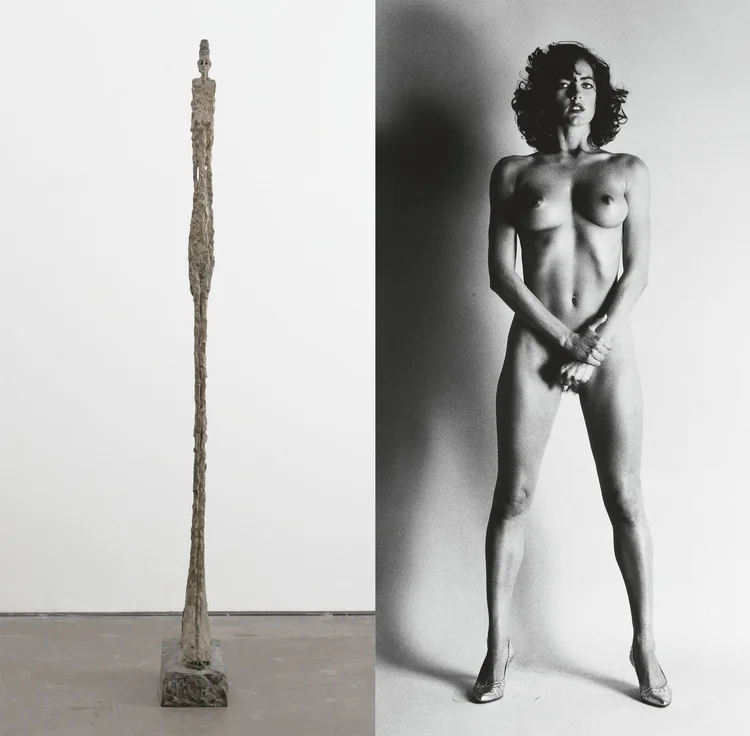
Left: Alberto Giacometti, Standing Woman, 1948. Right: Helmut Newton, Big Nude III: Henrietta, 1980 |
|
|
Standing Wom[e]n, Big NudesI'm looking at a photograph of a lank, figural sculpture. She stretches upward from a substantial base, squeezed disproportionately in the frame. The exaggerated legs, separated only by an indention, rise to slim hips. Arms hang from stiff shoulders. The indicators of sex appear careless–a hastily scratched triangle to mark the pubic area and modest peaks for breasts. Despite the slight profile of this body, she feels weighty, immobile; her feet are frozen in place, hands fused to her hips. This sculpture is Alberto Giacometti's Standing Woman from 1948. The elongated figures are Giacometti's most notable works, widely interpreted as expressions of post-war anxiety and isolation. Yet, there is a significant difference between Giacometti's renderings of standing women and walking men. Men act, women are frozen. Thirty years later, the fashion photographer Helmut Newton began making more conceptual work, notably in his Big Nudes series. The photographs are stripped-down studio portraits; each woman stands erect, nude, except for high heels. They are photographed head-on, reinforcing their statuesque bigness. In “Big Nude III, Henrietta,” the titular model stoically looks into the camera lens. Her shoulders are squared, fists clenched. These photographs were framed as feminist representations of the "modern woman…free from all social conventions and restrictions. Even clothes."[1] But while these women hold traditionally male power positions, they appear just as anxiety-laden and stuck as Giacometti's women. Henrietta's hands are clasped in front of her pubic area, more protective than powerful. Her gaze is uncertain–chin turned slightly to her left, forcing her into a semi-side eye. The confidence in her stance is pretense; a performance that reveals more uncertainty than power.
|
|
|
|
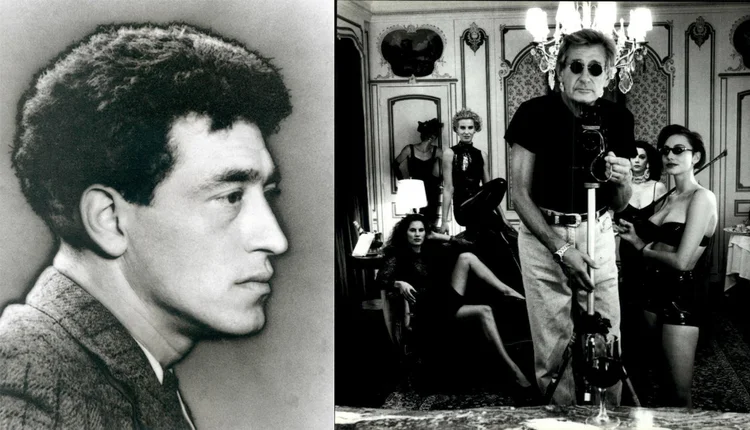
Left: Giacometti, Photograph by Man Ray, 1932. About a decade after his Venice experience, but maybe the solarized print alludes to his terror. Right: Helmut Newton, Self-Portrait with Models, 1991. |
|
|
Problems with RealityIn 1920, a nineteen-year-old Giacometti travels to Venice for the Biennale. He marvels at the city's art and architecture but is left traumatized by a seemingly benign experience. Walking through a piazza one day, a group of teenage girls cross his path: "They seemed immense, beyond all conception of measurement, and their whole being and their movements were charged with a dreadful violence. I stared at them, hallucinated, invaded by a sense of terror. It was like a hole torn in reality."[2]
This inexplicable experience altered Giacometti's perception of reality. He created a psychic and physical distance between himself and the world, making it more palatable, less terrorizing. The separation allowed for abstraction, both in his work and his life. Until, in 1946, he experienced a reversal—a sudden perceptual awakening as he stepped out of a cinema into a Parisian evening. People passed him on the street; he had a sensory experience. In Venice, he had separated himself from the flow of time, seeing his surroundings as a series of photographic frames. Now, he wondered: How could he reconcile a photographic view with a world embodied? While Giacometti's problems of perception were existential, Newton was conscious of photography's capacity to mediate reality. Newton understood photography as expressive and subjective. In his personal life, he placed the camera between himself and difficult experiences, using it to bear pain—like Giacometti, creating an abstraction of the world. Professionally, Newton used the camera to construct fantasies. His meticulously staged compositions are theatrical in both subject and style. His female models exude confidence—fierce and self-aware. But if these photographs are fictions, where does agency truly lie? Newton's wife, June, reveals the dynamic behind the camera: "He loves big women, statues, paintings, sculptures, live ones…he can manipulate them. He can control every muscle in their bodies."[3]
|
|
|
|
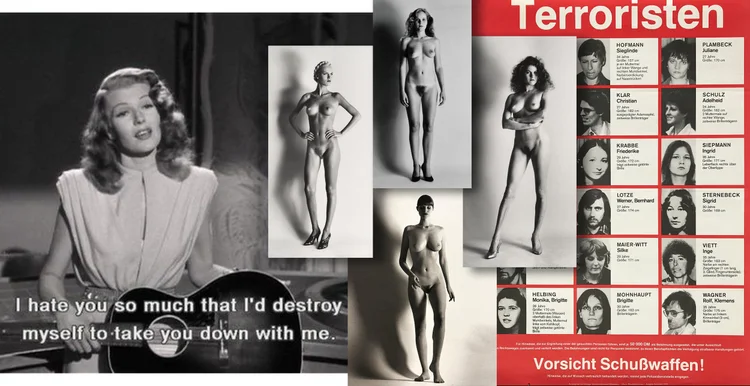
Left: Film still of Rita Heyworth from Gilda, 1946. Middle: Various Big Nudes, 1980-1983. Right: Red Army Faction (RAF) Wanted poster, 1979 |
|
|
Beautiful, DeadlyIn the 1940s, while Giacometti grappled with an existential crisis in Paris, two French designers competed to market the modern bikini. Jacques Heim introduced the Atome, named for its particle-like size. Heim's rival, Louis Réard, went even smaller, unveiling the Bikini—its name drawn from Operation Crossroads' nuclear tests at Bikini Atoll. So tiny were his "four triangles of nothing" that Réard had to hire nude model Micheline Bernardini to debut it.[4] On the eve of Operation Crossroads, Orson Welles remarked that his wife, Rita Hayworth, would have her likeness stenciled onto the bomb's nose. Chosen for her titular role in the film Gilda, Heyworth was horrified to be linked to such destruction. The film's tagline– "Beautiful, Deadly. . .Using all a woman's weapons"–captures the paradox of female sexuality and violence. If a woman's power is dangerous, it must be confined to images, transforming her into an object of desire and destruction. This double-bind reappears in Helmut Newton's Big Nudes, originally named: The Terrorists. Newton drew inspiration from the spectacle of the Red Army Faction (RAF), a far-left militant group in 1960s Germany. Though the RAF was not predominantly female, the media fixated on the idea of the 'radicalized' woman. Newton exploited this sensationalized narrative, styling his large-scale nudes after the stark, high-contrast police mugshots.[5] Shot frontally, the women appear to tower over the viewer, but their power is performative—frozen, exposed, and vulnerable to scrutiny.
|
|
|
|
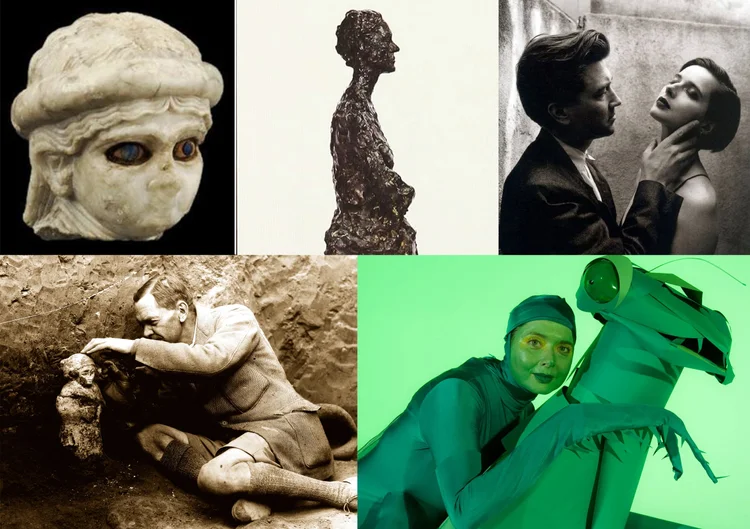
Clockwise from lower left: Leonard Woolley excavating at Enheduanna’s Temple (Ur); Head of a High Priestess from Ur; Giacometti’s portrait of Paola Caròla; Helmut Newton, David Lynch and Isabella Rossellini by Helmut Newton, Los Angeles, 1988; still from Isabella Rossellini’s Green Porno, 2008-9. Created by Rossellini, I thought this was an example of a more self-possessed performance. |
|
|
Makers and MusesThe first recorded author in history was a woman: Enheduanna, a Mesopotamian princess, high priestess, and poet. Her writings weren't unearthed until 1927, and her work is uniquely autobiographical and female. In her hymn to the Goddess Inanna, she describes "birthing" the poem. She appeals to the goddess for help with the power-hungry Lugalanne, who exiles Enheduanna from her temple– possibly through sexual violation.[6] For Leonard Woolley, the archaeologist who stumbled upon this significant discovery, it was so unfathomable that a woman might have authored these ancient cuniform tablets that he dismissed the evidence, "treating her as an inconsequential appendage of her famous [king] father."[7] Decades after Woolley, Paola Caròla, one of Giacometti's models, remarked, "I felt I was the immobile object and the sculpture was the lively presence."[8] Years later, Isabella Rossellini worked with Newton and reflected on her experience of being photographed: he was "photographing an idea in [his] head, and you are the vehicle."[9] An appendage.
An immobile object.
A vehicle. In the 1970s, second-wave feminists claimed Enheduanna, pushing for her recognition—an effort that would necessarily unravel great-man theories of history. Yet debates over her authorship resurface every few years, never reaching consensus. Despite being the author of her own story, Enheduanna remains contested, contained, and immobilized. Like the Standing Women and Big Nudes, she is leaden, straining for agency, to be heard in her own voice.
|
|
|
|
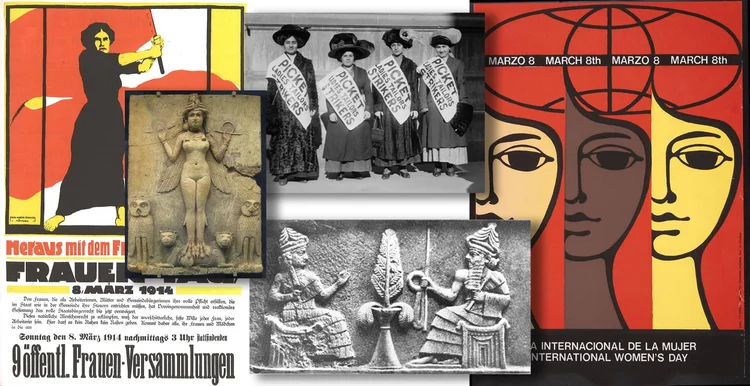
Left to right: Karl Maria Stadler, Poster for International Women’s Day, 1914; Burney Relief, Possibly Inanna, possibly her sister, 19th or 18th C. BCE; Theresa Malkiel (left) and other women protesting labor rights; A scene from Inanna and the God of Wisdom; Women's Graphics Collective, Poster for International Women’s Day, 1980 |
|
|
The Heroine's JourneyOne of the most ubiquitous goddesses of Enheduanna's era was Inanna, the goddess of love, war, and fertility. In the myth of Inanna and the God of Wisdom, Inanna begins by marveling "at her wondrous vulva," the source of her power. She is self-possessed. When she visits Enki, the God of Wisdom, he is entertained by the goddess's bravado and welcomes her with libations. As Enki drinks, he effusively, if in jest, offers her the riches of his kingdom. He is frivolous; she is full of intention. Testing her power, she accepts each gift until the final one—"the gift of making decisions." Realizing she has stripped Enki of his power, she flees. Enki, tricked, sends spirits to stop her. But she outwits them and returns to her homeland transformed, her self-possession now recognized as wisdom.[10] In 1909, Theresa Malkiel, the chair of the Women's National Committee of the Socialist Party of America, established a National Woman's Day as a protest for suffrage and labor rights. That same year, she wrote Where Do We Stand on the Woman Question?, arguing that women were conditioned into subservience under the guise of protection: "To those of us who had the courage and initiative to strike out for ourselves, the path is being covered with more thorns than roses. We are told very often to keep quiet about our rights and await the social millennium. Safe advice, rather, for the men."[11]
From ancient history to the present, women have named themselves and their power, yet dominant voices—historians, politicians, artists—continue to obscure them. Giacometti's Standing Women and Newton's Big Nudes reveal how women's power—even while seemingly asserted—remains precarious. If Inanna's myth is a heroine's journey toward self-possession, Giacometti and Newton depict something closer to the hero's gaze: a perspective that defines, frames, and contains the female form. Even when women appear monumentalized in art, their power is often an illusion—shaped by the artist's hand, the camera's eye, or the patriarchal lens of history. Fixed in place, just out of reach of true transformation. And yet; women stand. What choice do we have?
|
|
Sources:
[1] Phillips Auction, Catalog essay
[2] James Lord, A Giacometti Portrait
[3] Gero Von Boehm, Helmut Newton: The Bad and the Beautiful (lots of filler, but a good watch)
[4] Smithsonian Magazine, How the Summer of Atomic Bomb Testing Turned the Bikini Into a Phenomenon
[5] Christie’s Auction, Catalog
[6] Morgan Library, She Who Wrote: Enheduanna and Women of Mesopotamia
[7] The New Yorker, The Struggle to Unearth the World’s First Author
[8] The New York Times, Real Women Have Curves
[9] Newton doc (see 3)
[10] Diane Wolkstein, Inanna, queen of heaven and earth : her stories and hymns from Sumer
[11] Theresa Malkiel, Where Do We Stand on the Woman Question? Bonus if you need some Giacometti content: A short, horror-style studio visit with Giacometti from 1967 [sound on]
|
|
|
|