|
A meditation for the Full Hunter’s Moon͏ ͏ ͏ ͏ ͏ ͏ ͏ ͏ ͏ ͏ ͏ ͏ ͏ ͏ ͏ ͏ ͏ ͏ ͏ ͏ ͏ ͏ ͏ ͏ ͏ ͏ ͏ ͏ ͏ ͏ ͏ ͏ ͏ ͏ ͏ ͏ ͏ ͏ ͏ ͏ ͏ ͏ ͏ ͏ ͏ ͏ ͏ ͏ ͏ ͏ ͏ ͏ ͏ ͏ ͏ ͏ ͏ ͏ ͏ ͏ ͏ ͏ ͏ ͏ ͏ ͏ ͏ ͏ ͏ ͏ ͏ ͏ ͏ ͏ ͏ ͏ ͏ ͏ ͏ ͏ ͏ ͏ ͏ ͏ ͏ ͏ ͏ ͏ ͏ ͏ ͏ ͏ ͏ ͏ ͏ ͏ ͏ ͏ ͏ ͏ ͏ ͏ ͏ ͏ ͏ ͏ ͏ ͏ ͏ ͏ ͏ ͏ ͏ ͏ ͏ ͏ ͏ ͏ ͏ ͏ ͏ ͏ ͏ ͏ ͏ ͏ ͏ ͏ ͏ ͏ ͏ ͏ ͏ ͏ ͏ ͏ ͏ ͏ ͏ ͏ ͏ ͏ ͏ ͏ ͏ ͏ ͏ ͏ ͏ ͏ ͏ ͏ ͏ ͏ ͏ ͏ ͏ ͏ ͏ ͏ ͏ ͏ ͏ ͏ ͏ ͏ ͏ ͏ ͏ ͏ ͏ ͏ ͏ ͏ ͏ ͏ ͏ ͏ ͏ ͏ ͏ ͏ ͏ ͏ ͏ ͏ ͏ ͏ ͏ ͏ ͏ ͏ ͏ ͏ ͏ ͏ ͏ ͏ ͏ ͏ ͏ ͏ ͏ ͏ ͏ ͏ ͏ ͏ ͏ ͏ ͏ ͏ ͏ ͏ ͏ ͏ ͏ ͏ ͏ ͏ ͏ ͏ ͏ ͏ ͏ ͏ ͏ ͏ ͏ ͏ ͏ ͏ ͏ ͏ ͏ ͏ ͏ ͏ ͏ ͏ ͏ ͏ ͏ ͏ ͏ ͏ ͏ ͏ ͏ ͏ ͏ ͏ ͏ ͏ ͏
|
|
|
Kim Hoeckele, Society of Diana, Archival Pigment Print, 40 x 50 inches, 2024 |
|
|
|
|
Hello friends and colleagues, I’m writing with a couple of mini updates and, most notably, the beginning of some writing parallel to my photographs. Updates first: I’ve done a major website refresh with more work and information. Please take a moment to look around. I’m currently a Fall Guest Resident at Woodward Residency in Ridgewood, Queens. During the residency, I’m working on a series of essays related to photographs in my project, The Long Confidence. This email is the beginning of the project: The first essay is about the goddess Diana (the hunter, goddess of the moon, patron of fertility), Princess Diana, and Diana Prince (a.k.a. Wonder Woman), with a tiny appearance by Diana Ross. I’ll send essays quarterly, so as not to burden your inbox. I’ve included you because we’ve crossed paths, but of course, you can unsubscribe at the bottom of this newsletter. I hope you’ll stick around and let me know what you think! Please share if you know someone who would enjoy it :)
|
|
|
Clockwise from left: Titian, Diana and Actaeon, 1556-59; Lynda Carter as Wonder Woman on set, 1970s; Jacques Langevin, Princess Diana, security and driver fleeing the paparazzi, 1997. |
|
A Triple DeityActaeon, Prince of Thebes, surprises Diana while she bathes naked in a spring. Her head is turned away, toward the back windshield of the car. At least three photographers spied Diana, leading to a short, desperate chase that reached its tragic end in the underpass. They discovered that the cameraman drilled a hole in the back of her dressing room and someone caught him going back there to watch her. In her panic, Diana had splashed Actaeon with spring water. "It's like living in a goldfish bowl with all these people coming to look at you and you're just there swimming around in circles with no escape." As punishment for him gawking at her, Diana transformed Actaeon into a stag and then incited his hounds to turn on him and hunt him. How ironic that she’s a symbol of power and yet she was being preyed upon in her own dressing room. They expected the paparazzi to help Diana in the vehicle but were shocked when they started taking photographs. It was predatory.*
|
|
|
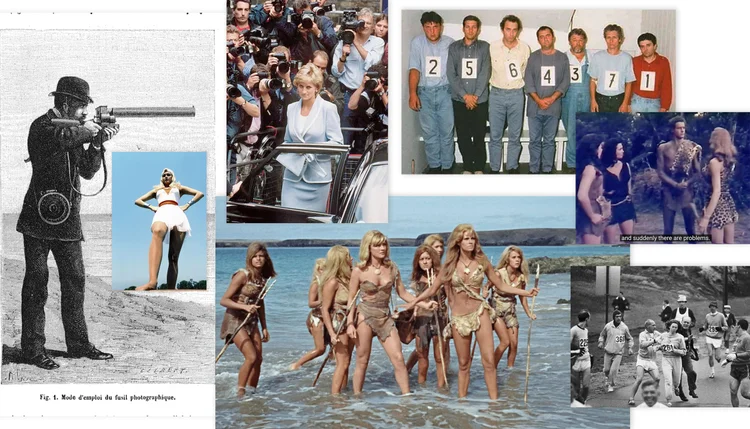
Clockwise from left: The Photographic Rifle, from an article by Étienne-Jules Marey, 1882; Lunda Carter as Amazon Diana in Wonder Woman, 1970s; Princess Diana and the paparazzi, Paparazzi lineup after Princess Diana’s crass in 1997; Film still from Prehistoric Women, 1967; Kathrine Switzer, the first woman to run the Boston Marathon (women were thought to be too frail), 1967; Film still from One Million Years B.C., 1966 |
|
Diana, the hunted huntressIn Susan Sontag’s oft-quoted text On Photography, she equates the camera to a gun, a predatory weapon. The notion that cameras share a vocabulary with guns is well-worn territory– we aim, we shoot, we capture. The paparazzi that hunted Princess Diana took this to a violent extreme ending in her fatal car crash in 1997, coining themselves “big game hunters.” A cameraman on the set of Wonder Woman drilled a hole into the back of a movable dressing room to spy on the actress Lynda Carter (a.k.a. Wonder Woman, a.k.a. Diana Prince). At her funeral in 1997, Princess Diana’s brother stated his sister was “the most hunted person of the modern age.” In Ancient Greek art and literature, the hunt is a metaphor for erotic desire. Comparisons between hunter and prey to lovers and the objects of their desire offer an easy shorthand, with women as wild animals who need taming. Archaic versions of the myth of Diana and Actaeon echo this sentiment, depicting Actaeon as a willful intruder overcome by sexual desire to capture the virgin goddess. But to Actaeon’s dismay, Diana defends herself. She spits, “Now tell how you have seen me nude, if you can tell.” This curse transforms him into a stag, and by the end of the myth, Actaeon has been ravaged by his own hunting dogs. In a later version, Ovid recasts Actaeon as innocent, lost in the woods, naively happening upon Diana in her bath. In this version, Diana is cruel, punishing Actaeon for a minor offense. Ovid has a personal stake in this revision– he has been exiled for witnessing a crime, “making his eyes guilty.” He reveals himself as an unreliable narrator. “We are all defined by our historical terms and conditions,” Jia Tolentino writes, “and these terms and conditions have been mostly written for and by men.” The theory that men hunt and women gather rose to prominence based on a 1966 symposium, Man the Hunter organized by anthropologists Richard Lee and Irven DeVore. Their theories purported that hunting was a major driver of evolution; men were biologically superior– the hunters– and women were the passive beneficiaries of evolutionary progress. In 2023, new and previously ignored evidence corrected the gendered hunter-gatherer myth. Women have always been hunters.
|
|
|
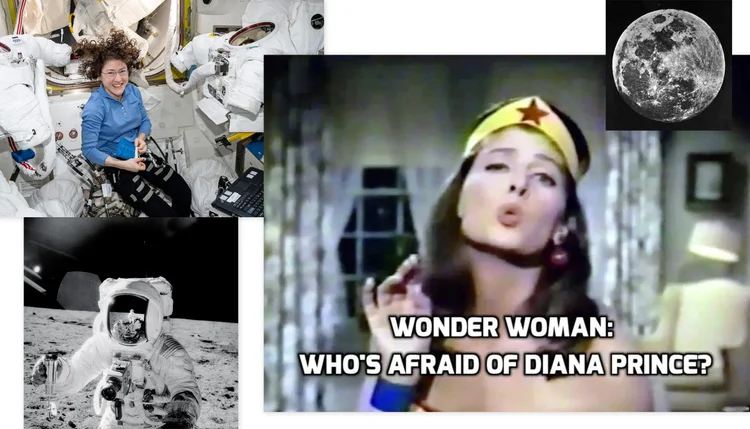
Clockwise from left: Christina Koch, slated to be part of the crew of Artemis II (Artemis-Greek, Diana-Roman). If successful, she will be the first woman to leave low Earth orbit; Dr. J. W. Draper, early photograph of the moon, 1840; Still from Who’s Afraid of Diana Prince?; Astronaut Alan L. Bean from Apollo 12, 1969 |
|
Who’s Afraid of Diana?In 1960, around the same time that Lee and DeVore were theorizing Man the Hunter, a NASA engineer named Abe Silverstein bestowed the name Apollo, god of the sun, upon the nascent manned space program. Apollo’s twin sister would have been a more fitting moniker: Diana, the goddess of the night and moon. Yet, NASA had no plans to include women in the space program, ignoring measurable evidence that women were physically and psychologically fit for space travel. The first attempted Apollo mission was launched in 1967. The same year, the producers of the popular Batman TV sitcom attempted their own launch: a comedy about Wonder Woman. The plot of Who’s Afraid of Diana Prince? centered Wonder Woman’s human alias as a bumbling, awkward, “plain-looking” woman. In the four-minute mini-pilot, Diana deflects her mother’s barbs about being single at 28 million years old as she tries to “save the Free World.” Diana slips away to make a sliding-doors transformation into Wonder Woman. The superhero emerges. Then, unexpectedly, we are subjected to a full 57-second sequence of Wonder Woman satisfyingly preening in front of a mirror. The message is clear: A woman’s only power lies in her beauty.
|
|
|
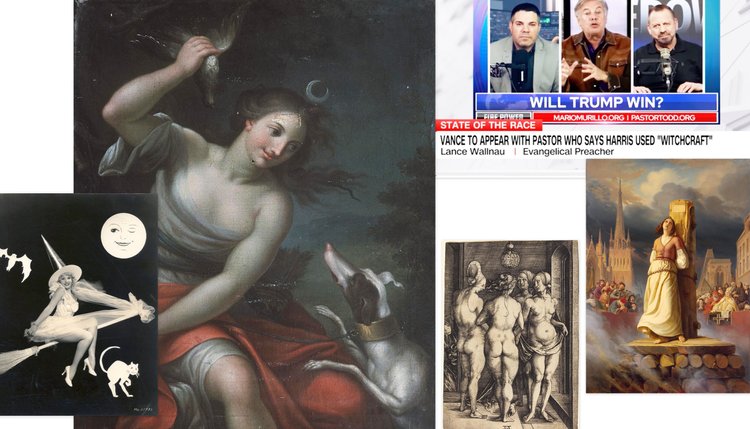
Clockwise from lower left: June Knight, 1938; Diana and her hound, c.1720; CNN response to Lance Wallnau; Hermann Stilke, Joan of Arc's Death at the Stake, 1843; Albrecht Dürer, The Four Witches, 1497 |
|
The Society of DianaIn place of Wonder Woman’s golden tiara, the goddess Diana was often depicted with a crescent moon in her hair, symbolizing her connection to the night sky. As the patroness of the moon– whose cycles have long been associated with feminine power– Diana was a protector of women. Worshippers to Diana shared important knowledge about childbirth and medicine, acting as midwives and folk doctors. In Medieval Europe, these mostly female healers and knowledge-keepers were deemed a threat to the growing power of the Christian church-state. They were branded as witches, the first in a succession of literal and metaphorical witch-hunts. Although the phrase “witch-hunt” has become an overused tactic to delegitimize perceived injustices, casting women as demonic witches remains a potent cultural and political strategy. In September 2024, evangelist Lance Wallnau said of Kamala Harris: “That’s the seduction of what I would say is witchcraft. That’s the manipulation of imagery that creates an impression contrary to the truth, but it seduces you into seeing it. So that spirit, that occult spirit, I believe is operating on her and through her.” J.D. Vance campaigned at an event organized by Wallnau the following weekend.
|
|
|
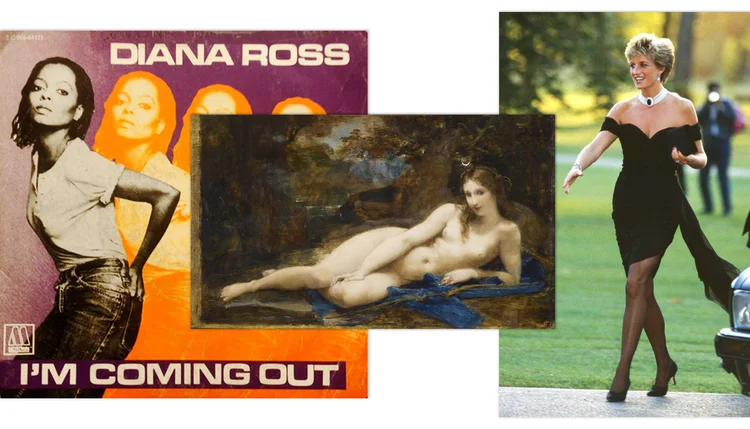
Left to right: French 7” cover for Diana Ross’s “I’m Coming Out”; Paul-Jacques-Aimé Baudry, Diana Reposing, c. 1859; Princess Diana’s ‘Revenge Dress.” |
|
An invocation for tonight’s full Hunter’s MoonI hadn’t really planned on weaving Kamala Harris into my writing, but Wallnau’s comments were too irresistible. Wallau bestows Harris with mystical power, while simultaneously belittling her intelligence (how else might she have been coherent during the presidential debate?). This echoes a similar double-bind Princess Diana faced: Before she was canonized in cultural memory, journalists and photographers accused Princess Diana of performing histrionically and manipulating the press. Princess Diana was not some hunted victim, the press claimed, rather she was the architect of her image. But what alternative did she have? The goddess Diana is sometimes invoked as Trivia, representing transitions and crossroads. For her worshippers, following Diana meant moving towards knowledge and away from barbarism. Under tonight’s full Hunter’s Moon, I invite you to call upon Diana’s wisdom as we, again, approach a crossroads. In this spirit I’ve compiled a Dianic incantation for this final full moon before Election Day: O My Goddess, Diana, hear my song of adoration. All the world is waiting for you
And the wonders that you do
In your satin tights
Fighting for our rights Teach me, O Diana. Give me Thy blessings, O Great Moon Goddess.
There's a new me coming out and I just had to live
And I wanna give, I'm completely positive Give us wisdom, O Diana: how to bind our oppressors, how to cure the sick among us.
I'm spreadin' love, there is no need to fear
And I just feel so good, every time I hear
I'm coming out, I want the world to know Now the Full Moon shines upon me.
Make a hawk a dove
Stop a war with love
Make a liar tell the truth
Descend and conquer, Gracious Goddess Diana**
|
|
🌝 Happy full Hunter’s Moon! And, thanks for your attention. Again, I’d love to hear your thoughts—and if you know someone who would enjoy this, please share!
|
|
*Text assembled (and lightly edited) from the following sources: Historytoday.com, Telegram.com, thegaurdian.com, Lynda Carter on Dr. Oz, USA Today, Ovid’s Metamorphoses **Text assembled (and lightly edited) from the following sources: Dragonoak.com, Diana Ross, “I’m Coming Out”, Wonder Woman theme song.
|
|
|
|